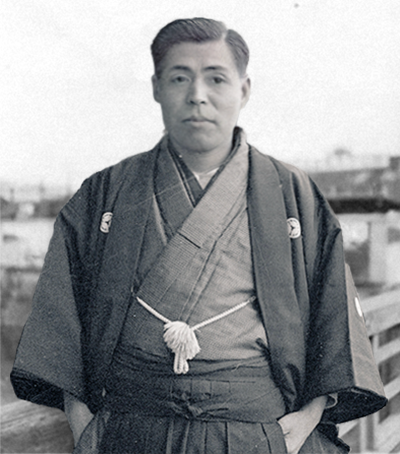
Kensei Tamaki (賢清玉木 - ケンセイ タマキ) (1898-1979), was born in Urasoe, Okinawa, into a period when karate existed as a private and largely undocumented practice rather than a public or formalised art. His early life reflects the reality of pre-modern Okinawan society, where martial knowledge was transmitted informally through family, social networks, and local context rather than through organised instruction.
His exposure to karate occurred within this private environment, shaped primarily by family transmission and observation rather than structured teaching. Like many Okinawans of his generation, any martial practice he encountered was integrated into daily life rather than separated as a distinct system of study.
Kensei Tamaki did not teach publicly nor seek recognition as a martial artist. His significance lies in the environment he provided for the next generation. Through personal example, discipline, and adherence to traditional values, he influenced the upbringing of his son, Katsumi Tamaki, during a period that preceded the formal naming and systemisation of karate traditions.
By the time karate began to emerge publicly in the early twentieth century, Kensei Tamaki belonged to an older generation for whom the art had remained private, personal, and undocumented. His role is best understood as part of the cultural and familial background from which later developments emerged, rather than as a technical authority within a defined system.
In 1979, after the passing of Kensei Tamaki, his son Katsumi Tamaki gave the name Shinjin-ryu in his memory. For this reason, Kensei Tamaki remains central to the history and meaning of the tradition.

Courtesy of Katsumi Tamaki